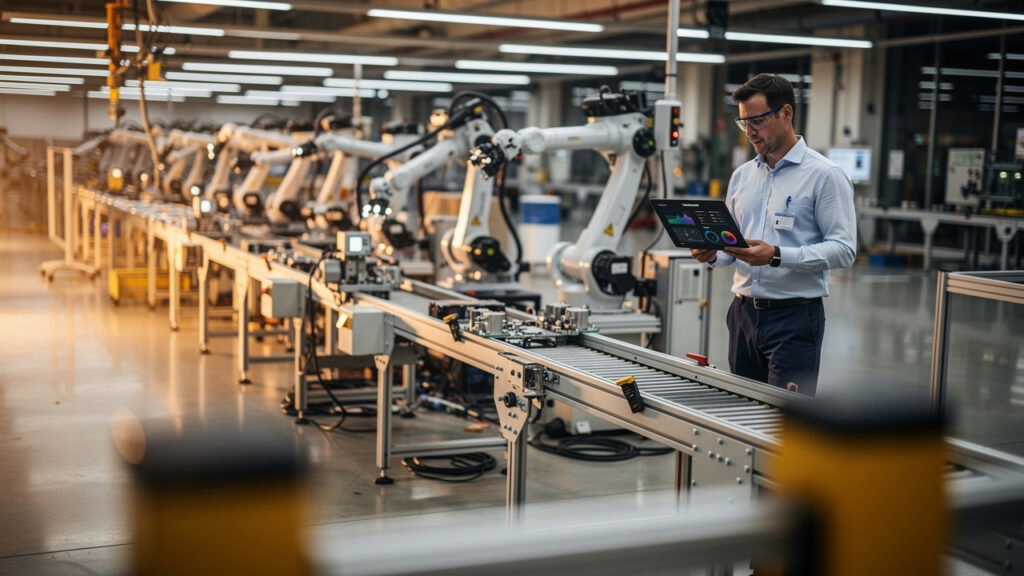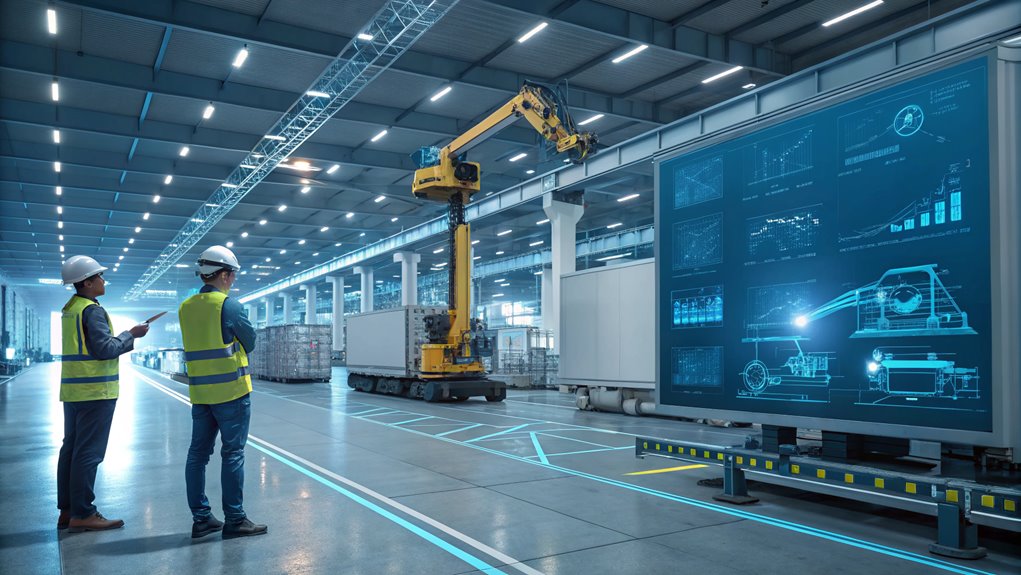
You’re witnessing AI transform manufacturing supply chains into self-optimizing networks that achieve 98% forecast accuracy while cutting defect rates by 90% through automated inspections. The market’s exploding from $14.49B to $50.01B by 2031, with 64% of leaders already implementing solutions. Machine learning algorithms predict demand 14 days ahead, IoT sensors enable real-time visibility, and digital twins simulate scenarios before disruptions hit. These converging technologies unleash 30-40% productivity gains manufacturers can’t afford to miss.
Key Takeaways
- Manufacturing-specific AI market reaches $5.79B in 2025, transforming production planning, quality control, and inventory management across global supply chains.
- Machine learning algorithms achieve 98% demand forecast accuracy, reducing errors by 30-50% and cutting stockout-related lost sales by 65%.
- AI-powered computer vision delivers 90% better defect detection rates, identifying flaws invisible to human inspectors during real-time production.
- IoT sensors and digital twins enable predictive maintenance, achieving 30-40% warehouse productivity improvements and 20% on-time delivery increases.
- 64% of supply chain leaders currently implement AI solutions, with 94% planning AI adoption for enhanced decision support capabilities.
Current Market Size and Growth Projections for AI-Driven Supply Chains
While traditional supply chains struggle with visibility gaps and manual forecasting errors, AI-driven systems are transforming how manufacturers orchestrate their global operations—and the numbers prove it’s not just hype. You’re looking at a market that’ll explode from $14.49B in 2025 to $50.01B by 2031, maintaining a 22.9% CAGR. Manufacturing-specific AI already commands $5.79B this year, while logistics AI dominates at $20.8B.
What’s driving this growth? Your peers are achieving 15% logistics cost reductions and 35% inventory improvements through AI-powered compliance risk management and automated supplier collaboration strategies. The retail sector leads adoption with substantial market share, using AI to enhance customer experience and optimize inventory management. With 64% of supply chain leaders already implementing AI solutions and 94% planning AI for decision support, you can’t afford to wait. The convergence of manufacturing, logistics, and supply chain AI creates an integrated stack that’s reshaping competitive dynamics.
Machine Learning Applications Transforming Demand Forecasting
Machine learning algorithms are revolutionizing how manufacturers predict what customers will buy, when they’ll buy it, and in what quantities—delivering forecast accuracy rates of 98% compared to traditional methods’ 60-70% ceiling. You’re now able to reduce forecast errors by 30-50% while cutting stockout-related lost sales by 65%.
Your ML systems integrate real-time social media sentiment, weather patterns, and competitive data to predict demand shifts 14 days ahead. They’ll detect anomalies through neural networks, excluding outliers that would skew predictions. For new products, you can leverage web analytics and attribute clustering to forecast lifecycle patterns without historical data. Advanced algorithms excel at recognizing over 200 micro-climates and intricate seasonal patterns that traditional statistical methods miss entirely.
These capabilities enable dynamic pricing strategies across your portfolio while supporting multi echelon optimization throughout distribution networks. You’re ultimately lowering inventory levels by 20-50% and warehousing costs by up to 40%.
Quality Control Enhancement Through Automated AI Inspections
When you deploy AI-powered computer vision on your production lines, you’re fundamentally transforming quality control from a sampling-based bottleneck into a thorough, real-time inspection system that examines 100% of your products at speeds reaching 67,000 profiles per second.
You’ll achieve 90% better defect detection rates while identifying flaws invisible to human inspectors. Major manufacturers like BMW uses AI to inspect critical welds on car bodies, ensuring every vehicle meets stringent safety standards. Your deep learning algorithms continuously refine through each inspection, establishing continuous quality improvement cycles that adapt without reprogramming. This enables flexible product customization strategies since AI systems distinguish acceptable variations from actual defects.
IoT and Digital Twin Integration for Real-Time Supply Chain Visibility
You’ll transform your manufacturing supply chain by deploying IoT sensor networks across warehouses, transport vehicles, and production facilities to capture real-time temperature, humidity, and equipment performance data that feeds directly into digital twin systems. These virtual replicas of your physical operations leverage AI-powered predictive analytics to forecast disruptions, optimize inventory levels, and identify bottlenecks before they impact production—with companies like BMW and Samsung already seeing significant efficiency gains from their implementations. The digital twin technology enables automatic schedule adjustments that maintain service levels while dynamically rerouting logistics to minimize the impact of unexpected supply chain disruptions. By integrating continuous IoT data streams with digital twin simulations, you’re positioned to achieve the 30-40% warehouse productivity improvements and 20% on-time delivery increases that leading manufacturers are capturing through this technology convergence.
IoT Sensor Networks
As manufacturing supply chains become increasingly complex and distributed, IoT sensor networks serve as the critical data layer that transforms physical operations into actionable digital intelligence. You’re witnessing explosive growth—from $478B in 2025 to $798B by 2032—as wireless sensors blanket your logistics infrastructure. These networks feed high-frequency data into control towers and digital twins, enabling real-time synchronization between physical and digital operations. Real-time IoT data enables early warning detection of potential disruptions before they cascade through your supply chain.
Your deployment priorities should focus on:
- Industrial IoT sensors streaming machine performance metrics directly into planning systems
- Environmental monitoring protecting pharmaceuticals and sensitive components through temperature/humidity tracking
- Location-based tracking reducing RTI losses while improving dock scheduling
However, you’ll need robust sensor network security protocols and regular sensor calibration accuracy checks to maintain data integrity across these mission-critical systems.
Digital Twin Benefits
The sensor networks feeding your operations generate massive data streams, but without digital twin technology, you’re only capturing snapshots rather than building dynamic operational intelligence. You’ll transform these inputs into thorough virtual replicas that simulate your entire supply chain ecosystem.
| Digital Twin Capability | Performance Impact | Strategic Value |
|---|---|---|
| Real-Time Visibility | 360° operational view | Multi enterprise optimization |
| Predictive Analytics | 50-80% downtime reduction | Proactive risk mitigation |
| Scenario Planning | Risk-free testing environment | Collaborative decision making |
| Inventory Optimization | 20-30% forecast accuracy gain | Reduced holding costs |
| Route Optimization | 8% freight reduction | Enhanced delivery performance |
Your digital twin integrates IoT data with AI-powered analytics, enabling you to predict disruptions before they escalate. The technology maps your environmental conditions throughout storage and transit, ensuring product quality while providing real-time alerts for temperature, humidity, or vibration anomalies. You’re not just monitoring—you’re simulating supplier delays, testing strategic decisions, and optimizing inventory across competing priorities. This virtual environment becomes your command center for collaborative decision making across partners.
Real-Time Data Analytics
While your digital twin simulates potential scenarios, it’s the continuous stream of IoT sensor data that transforms these models from static representations into living, breathing operational intelligence. You’re capturing real-time telemetry across your supply chain—temperature, location, humidity—feeding these insights directly into cloud-based analytics platforms. Your edge computing infrastructure processes this data instantly, despite data integration obstacles that limit only 6% of businesses to full visibility. The interconnected nature of these networks expands market access but introduces geopolitical uncertainties that can cascade through your entire operation.
You’ll leverage this IoT-twin synchronization to:
- Monitor 25.1 billion endpoints generating predictive maintenance alerts
- Track shipments with 78% adoption rates among high-performers
- Detect anomalies through automated cloud services
Though human AI collaboration barriers persist, you’re building dashboards that expose bottlenecks while reducing detection delays. With the market reaching $290.2 billion by 2032, you can’t afford episodic checkpoints anymore.
Cost Reduction and Efficiency Metrics Achieved Through AI Implementation
When you implement AI across your manufacturing supply chain, you’ll typically see operational costs drop by 10-20%, with procurement functions achieving reductions of 15-45% depending on the category. Your inventory levels can improve by 35% while maintaining a 98% in-stock rate, effectively cutting carrying costs by 15% through AI-powered demand forecasting that reduces errors by 20-50%. Companies like Tesla demonstrate this impact by using AI-powered robots to automate manufacturing processes, achieving faster time to market while significantly lowering production costs. These efficiency gains translate directly to defect reduction metrics, as AI’s predictive capabilities optimize production planning and quality control processes across your entire manufacturing network.
Operational Cost Savings
Three decades ago, a 10% reduction in manufacturing costs would’ve been considered revolutionary—yet today’s AI implementations are delivering savings that dwarf those benchmarks, with some facilities reporting operational cost reductions exceeding 40%. You’re witnessing unprecedented transformations through AI-powered process automation improvements that eliminate inefficiencies across your entire operation. By aggregating data 90% faster, you’ll identify savings opportunities that manual analysis would miss. AI-driven predictive maintenance alone achieves downtime reductions of more than 50%, directly impacting your bottom line through increased equipment availability.
Consider these game-changing impacts:
- Energy optimization slashes costs by 20% through intelligent scheduling and equipment balancing
- Procurement functions achieve 15-45% reductions via AI-streamlined operations
- Cross-functional integration yields 45% greater savings than siloed initiatives
Your skill gap reduction strategies become secondary when AI handles complex analysis automatically. You’ll maximize ROI within 12-24 months while positioning your facility for sustained competitive advantage through data-driven decision-making.
Inventory Optimization Results
You’ve likely struggled with the classic inventory dilemma—carry too much and drain working capital, or cut too lean and risk stockouts that cripple production lines. AI-powered optimization transforms this challenge into measurable wins. Manufacturing deployments show 95% demand satisfaction while boosting profitability by 14%, proving you can optimize both service and inventory cost reduction simultaneously. The integration of real-time IoT data streams enables dynamic policy reconfiguration that adapts to spontaneous demand peaks and sales oscillations.
Your demand volatility management improves dramatically—AI systems respond to changes 30% faster than traditional methods, virtually eliminating stockouts. One manufacturer reduced shortages to a single instance over months while maintaining stable inventory levels. You’ll see working capital free up as AI identifies excess stock, with some operations reporting multi-million dollar savings within 10-week trials. Planning cycles compress from weeks to hours through automated forecasting and replenishment triggers, while inventory turnover increases by 20%.
Defect Reduction Metrics
Manufacturing defects don’t just damage products—they’re destroying your bottom line through rework costs, warranty claims, and production delays that compound across your supply chain. You’re watching profit margins evaporate while competitors leverage AI-driven defect prediction to achieve near-zero failure rates.
Today’s manufacturers are transforming quality control through:
- 66% defect reduction using predictive models that identify parameter drift before production issues occur
- 97% detection accuracy via computer vision systems performing real-time quality assurance at every stage
- 50% faster development cycles by forecasting quality issues through process correlation analysis
You’ll see dramatic efficiency gains when AI analyzes temperature, humidity, and material properties to predict failures. These systems don’t just catch defects—they prevent them by alerting operators to recalibrate before problems emerge, cutting waste and eliminating downstream supply chain disruptions. The AI continuously learns from each production run, enhancing its ability to spot outliers in machine performance that signal imminent quality issues.
Predictive Maintenance and Disruption Management Systems
Predictive maintenance systems are breaking through traditional manufacturing barriers, transforming how you’ll manage equipment health and prevent costly disruptions in your supply chain. You’re looking at 30-50% reductions in unplanned downtime when implementing AI-driven reliability centered maintenance across your operations. Smart sensors and machine learning models analyze vibration patterns and performance shifts, detecting failure signs before they impact production.
Your prescriptive maintenance strategies will leverage real-time data analytics to recommend ideal repair timing, extending asset life by 40% while cutting maintenance costs by 30-40% compared to reactive approaches. The global predictive maintenance market is projected to reach USD 44 billion by 2032, growing at a 22% CAGR as manufacturers recognize its critical value. Edge computing enables instant anomaly detection near machines, while digital twins enhance diagnostic precision. With manufacturers losing over $100,000 per hour to unplanned downtime, you’ll find AI-powered predictive maintenance isn’t optional—it’s strategic necessity for supply chain resilience.
Legacy Infrastructure Challenges Limiting AI Adoption
While AI-powered predictive maintenance systems promise transformative results, you’re facing a harsh reality: 92% of manufacturers report that outdated technologies block critical AI initiatives across their supply chains. Your monolithic architectures can’t host modern AI components, creating severe deployment challenges across ERP, MES, and WMS platforms. Legacy systems built for batch processing struggle with real-time AI inference, while 47% of manufacturers identify data fragmentation as their primary obstacle. Despite these challenges, less than half have assessed their infrastructure readiness for AI implementation.
92% of manufacturers can’t deploy AI because monolithic architectures block modern components across critical supply chain systems.
You’re confronting three critical barriers:
- Technical incompatibility – Outdated APIs and proprietary protocols prevent seamless AI integration
- Data silos – Fragmented information across plants undermines model accuracy
- Performance limits – Constrained infrastructure can’t support enterprise-scale AI workloads
Without addressing workforce skill gaps in modernization strategies, you’ll remain locked in isolated pilots rather than achieving network-wide AI transformation.
Transport Route Optimization and Logistics Management Solutions
Every mile your fleet travels costs money, yet AI-powered route optimization engines are transforming this equation by processing real-time traffic, weather, and road restrictions to slash operational expenses by 5-20%. You’re witnessing dynamic routing reduce fuel consumption by up to 20% while improving on-time arrivals by 35%. These systems respect vehicle capacity, driver hours, and legal constraints while minimizing total distance traveled.
Your real time route monitoring capabilities now enable rerouting within seconds of disruption detection, maintaining service levels that weren’t possible before. Major logistics players are integrating AI platforms with traffic data, weather patterns, and vehicle metrics to achieve unprecedented operational efficiency. As autonomous trucking solutions mature, they’ll integrate seamlessly with these optimization platforms, further reducing deadhead miles by 10-15%. You can achieve 18% cost savings on last-mile delivery by linking AI routing with inventory data, transforming minutes-long planning cycles that once took hours.
Data Standardization Requirements for Scalable AI Deployment
Your AI-powered routing systems won’t deliver their full potential without addressing the foundation beneath them: standardized, high-quality data flowing seamlessly across your manufacturing ecosystem. You’ll need robust data quality monitoring frameworks that validate sensor readings against physical constraints while enforcing completeness thresholds across batches and time-series data. Without data harmonization, your AI models will generate flawed predictions when shipment IDs from your TMS don’t match the same identifiers in your ERP, WMS, and customer service platforms. Your master data management solutions must establish:
- Common identifiers spanning ERP, MES, WMS, and QMS systems to reference entities consistently
- Unified schemas with standardized engineering units preventing conversion errors in optimization models
- Protocol normalization using OPC UA and MQTT for legacy equipment integration
You can’t scale AI without harmonizing heterogeneous OT/IT systems through time synchronization and centralized data lakes. Implement lineage mechanisms for audit trails and deploy AI-assisted mapping tools to align machine tags automatically across your supply chain.
Frequently Asked Questions
What Initial Investment Is Typically Required to Implement AI in Manufacturing Supply Chains?
You’ll typically invest $50,000-$250,000 for predictive maintenance and procurement optimization systems, though complex implementations reach $2 million. Your data-driven strategy should prioritize high-ROI applications first, expecting 9-14 month payback periods with 15-40% operational improvements.
How Long Does It Take to See ROI From AI Supply Chain Implementations?
While others wait years for returns, you’ll see initial value within 6-10 weeks. Your inventory optimization and demand forecasting initiatives typically achieve full payback in 12-18 months, with 220-350% ROI materializing as systems mature strategically.
Which Specific AI Vendors or Platforms Are Leading in Manufacturing Supply Chain Solutions?
You’ll find Blue Yonder’s Cognitive Solutions, SAP IBP, and Oracle SCM Cloud leading with their machine learning algorithms. IBM Sterling and Everstream Analytics excel through predictive analytics capabilities, transforming your manufacturing operations with real-time insights and automated decision-making.
What Skills and Training Do Employees Need for Ai-Driven Supply Chain Management?
You’ll need strong data analysis skills, machine learning proficiency, and strategic thinking capabilities. Overcoming technology adoption challenges requires continuous upskilling through structured programs, cross-functional training, and developing change management mindsets to translate AI insights into actionable business decisions.
How Do Small Manufacturers Start With AI When Lacking Resources of Larger Companies?
You don’t need Fortune 500 budgets to revolutionize operations. Start with cloud-based pilots, increasing data integration through accessible IoT tools. Focus on leveraging predictive analytics for inventory optimization—small wins compound into transformative supply chain efficiency gains.
Conclusion
You’re standing at the crossroads of manufacturing evolution. While legacy system overhauls seem formidable, consider this: companies implementing phased AI integration report 23% supply chain cost reductions within 18 months. You don’t need complete infrastructure replacement—start with modular solutions that’ll plug into existing frameworks. Your competitors aren’t waiting. By 2025, AI-driven supply chains will dominate 65% of manufacturing logistics. The question isn’t whether you’ll adopt these technologies, but how quickly you’ll move to capture first-mover advantages.