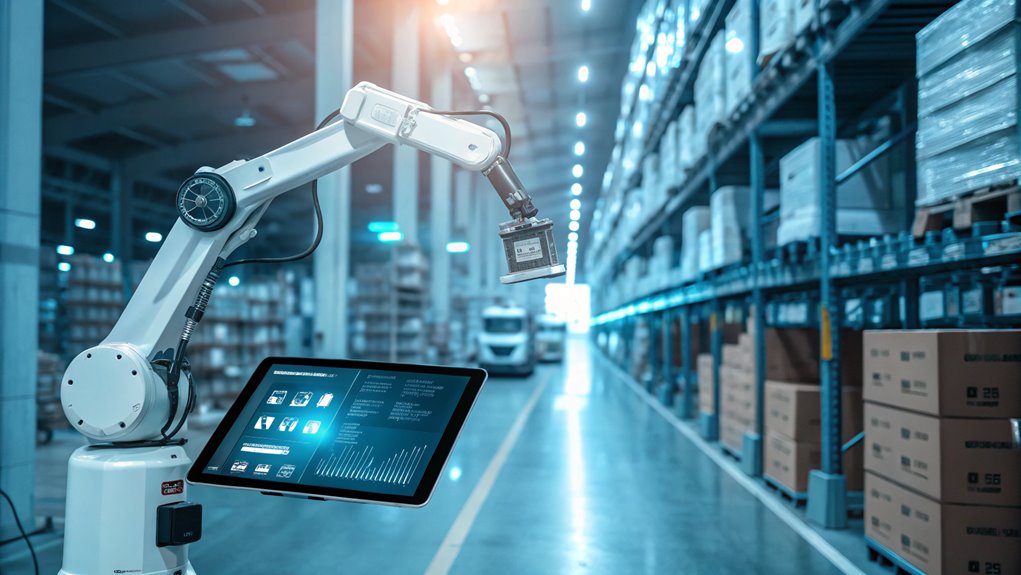
Automation is rapidly transforming how that engine runs. Today, companies no longer automate just to cut costs; they automate to remove friction, boost speed, enhance accuracy, and build resilience in a world where disruptions have become the new normal.
Types of Supply Chain Automation
Supply chain automation appears in three core forms, each targeting a different layer of operations. From warehouse robotics that speed up physical movement, to workflow automation that eliminates manual tasks, to AI systems that make smarter, faster decisions — these categories define how modern supply chains evolve and scale.
- Physical Automation (e.g., AMRs, AGVs, AS/RS, conveyors, robotic picking)
- Process Automation (e.g., RPA, auto-replenishment, automated workflows, TMS auto-selection)
- Cognitive Automation (e.g., AI predictions, digital twins, control towers, predictive ETA)
Physical Automation in the Supply Chain
Physical automation is all about machines taking over material-handling tasks that humans traditionally performed. This includes robots, conveyors, automated storage, and robotic arms, all working together to make warehouses and fulfillment centers faster, safer, and more efficient.
Key Benefits of Physical Automation
- Speeds up operations and reduces delays
- Minimizes errors and damages
- Optimizes storage space
- Reduces reliance on manual labor
- Improves safety in the workplace
Main Types of Physical Automation
| Type | Description | Typical Uses | Benefits |
|---|---|---|---|
| AMRs (Autonomous Mobile Robots) | Smart robots moving independently inside warehouses | Pick-to-robot, goods-to-person, tote transport | Flexible, quick deployment, no fixed infrastructure |
| AGVs (Automated Guided Vehicles) | Follow fixed paths using magnetic tape or QR markers | Pallet movement, shuttle operations | Good for repetitive, predictable routes |
| AS/RS (Automated Storage & Retrieval Systems) | High-density storage systems with cranes or shuttles | High-volume picking, e-commerce, pharma | Maximum storage density, high throughput, fast picking |
| Conveyors & Sortation Systems | Moving goods between zones or for shipping | Carton movement, high-speed sortation | Backbone of warehouse automation, handles bulk efficiently |
| Robotic Picking Arms | Robots with AI vision and grippers for item picking | E-commerce small items, apparel, grocery | Handles delicate or small items, scalable, precise |
Process Automation in the Supply Chain
Process Automation, also known as Digital Workflow Automation, is the “invisible robot” that works inside software systems rather than moving physical goods. It automates repetitive, rule-based tasks across procurement, inventory, order management, logistics, and finance — moving data, approvals, and decisions automatically. The result is faster operations, fewer errors, cost savings, and freeing humans to focus on strategic, high-value tasks.
Where Process Automation Happens
- Procurement & Sourcing: Auto PO creation, supplier approvals, invoice matching
- Inventory Management: Reorder triggers, stock transfer approvals, alerts for slow-moving items
- Order Management: Auto order allocation, customer notifications, credit/fraud checks
- Logistics & Transportation: Carrier selection, label generation, routing adjustments
- Finance & Billing: Auto invoicing, payment reminders, expense approvals, reconciliation
Supply Chain Process Automation Tools & Technologies
| Tool / Tech | Purpose |
|---|---|
| RPA (UiPath, Automation Anywhere) | Automates repetitive ERP or email tasks |
| ERP Workflow Automation (SAP, Oracle) | Streamlines approval and data processes |
| Integration Platforms (MuleSoft, Workato) | Connects multiple systems seamlessly |
| AI-assisted decision-making | Auto-prioritization, predictive alerts |
| Low-code platforms (Power Automate, Appian) | Build custom workflows quickly |
Benefits of Supply Chain Process Automation
| Benefit | Impact |
|---|---|
| Speed | Approvals in seconds instead of hours |
| Accuracy | Eliminates manual data-entry errors |
| Compliance | Automatic audit trails |
| Cost Savings | Reduces admin workload |
| Scalability | Handles thousands of transactions without extra staff |
Cognitive Automation(Intelligent Automation) in the Supply Chain
Cognitive Automation represents the most advanced layer of supply chain automation, where AI, machine learning, and advanced analytics combine to make the supply chain predictive, adaptive, and self-optimizing. Unlike physical or process automation, cognitive automation doesn’t just move goods or data — it analyzes complex patterns, predicts outcomes, and makes decisions automatically, handling dynamic, unstructured problems that humans traditionally managed.
Where Cognitive Automation Works
- Demand Forecasting & Planning: AI predicts customer demand and adjusts replenishment plans automatically
- Inventory Optimization: Suggests optimal stock levels and warehouse transfers
- Dynamic Pricing & Promotions: Recommends price adjustments based on real-time demand and inventory
- Logistics & Transportation: Predictive ETAs, route optimization, and exception management
- Supplier & Risk Management: Monitors suppliers, forecasts disruptions, recommends alternatives
- Control Tower Operations: Central “brain” detecting anomalies and executing corrective actions in real-time

Technologies Behind Cognitive Automation
| Technology | Use Case |
|---|---|
| Machine Learning / Deep Learning | Forecasting, anomaly detection |
| Natural Language Processing (NLP) | Reads unstructured data like emails, news, contracts |
| Digital Twins | Simulates the supply chain for scenario testing |
| Advanced Optimization Algorithms | Multi-echelon inventory, routing, scheduling |
| Integration Platforms / APIs | Connect ERP, WMS, TMS, IoT sensors, and control towers |
Key Benefits of Cognitive Automation
| Benefit | Impact |
|---|---|
| Real-time decisions | Automatic rerouting due to disruptions |
| Predictive capabilities | Reduce stock-outs by 30–50% |
| Cost efficiency | Lower emergency shipments and carrying costs |
| Service level improvement | Faster deliveries, higher customer satisfaction |
| Risk mitigation | Early detection of supplier or demand disruptions |
Cognitive automation is turning supply chains into intelligent, self-learning networks, enabling companies to react faster, plan smarter, and deliver better results with minimal human intervention.
Examples of Supply Chain Automation: Real-Life Use Cases
Supply chain automation isn’t just a concept — it’s happening right now in companies of all sizes, across multiple industries. From warehouses using robots to move products, to AI predicting demand, to software bots handling repetitive data tasks, automation is improving speed, accuracy, and efficiency at every step. Real-world examples make it clear how these technologies are applied and the tangible benefits they deliver.
- Amazon Fulfillment Centers: AMRs and robotic arms move and pick millions of items daily.
- Walmart: RPA(Robotic process automation) bots automate purchase orders, invoice processing, and inventory updates.
- Maersk / DHL Logistics: AI-driven route optimization and predictive ETA reduce delays and shipping costs.
- AutoStore Systems: High-density storage and shuttle systems optimize space and throughput.
- Coca-Cola / Nestlé: Cognitive automation predicts demand spikes and dynamically adjusts inventory and production.
- FedEx / UPS: Smart sortation and conveyor systems handle millions of parcels efficiently.
Supply Chain Automation for SMBs
Small and medium-sized businesses (SMBs) can reap big benefits from automation, even without the budgets of giants like Amazon or Walmart. By selectively implementing automation, SMBs can save time, reduce errors, scale efficiently, and meet customer expectations without adding excessive headcount or costs.
Why SMBs Should Consider Automation
- Limited resources: Every dollar and labor hour counts
- Scalability needs: Handle growth without large teams
- Customer expectations: Fast, accurate orders are now standard
- Competition: Efficiency and accuracy help compete with larger players
Types of Automation SMBs Can Adopt
| Automation Type | Why SMBs Use It | Examples | Tools | Impact |
|---|---|---|---|---|
| Process Automation | Low cost, quick ROI | RPA for order entry, auto-invoicing, inventory alerts | Zapier, Make, Power Automate, Shopify Flow | Saves hours per week, reduces errors, faster customer response |
| Cognitive Automation | Moderate adoption, predictive insights | Demand forecasting, dynamic routing, supplier risk alerts | Forecast, Lokad, o9 Solutions, Tableau + AI plugins | Smarter inventory, fewer stock-outs, better cash flow |
| Physical Automation | High investment, selective adoption | Small AMRs, compact conveyors, cobots | MiR robots, Locus Robotics, AutoStore (compact) | Faster picking/packing, fewer errors, safer work environment |
SMB Automation Strategy
- Map workflows → Identify repetitive tasks and bottlenecks
- Start small with process automation → RPA, workflow apps
- Introduce cloud-based AI for predictive insights → demand, supplier risk, routing
- Add physical automation only when volume justifies → modular, scalable solutions
- Integrate into ERP/WMS/TMS → single source of truth
Even partial automation — focusing on processes and decision-making — can dramatically improve efficiency, accuracy, and growth potential for SMBs.
Costs and ROI of Supply Chain Automation
Supply chain automation — especially in warehousing and logistics — can be costly, but the investment depends heavily on scope and scale. From small, targeted improvements to fully robotic warehouses, costs vary widely, and so does the expected ROI.
Typical Cost Ranges
| Level / Scope of Automation | Typical Cost Range / Notes |
|---|---|
| Small / targeted automation | US $50,000 – $500,000 |
| Entry-level/modest-scale | US $250,000 – $1 million+ |
| Mid-sized / Semi-automated | US $500,000 – $5 million |
| Large / High-throughput | US $5 million – $15 million+ |
| Very advanced / “lights-out” | €20–50 million+ |
Cost by Component (Examples)
- AGVs: Tens of thousands USD per unit; full fleets raise costs substantially
- Robotic Picking Arms: Hundreds of thousands to over $1 million depending on scale
- AS/RS / Shuttle Systems: Often millions for mid-size centers
- Software / Integration / Control Systems: WMS/WES licensing, ERP integration, custom middleware
- Infrastructure Modifications: Electrical, networking, building layout, safety systems
- Operational & Maintenance Costs: 5–15% of initial equipment cost per year
Factors Driving Cost
- Scope & ambition — Small upgrades vs full automation
- Warehouse size & layout — Larger facilities require more equipment and integration
- Throughput requirements & SKU complexity
- Level of automation — Semi-automation vs fully robotic
- Integration complexity — Linking hardware with ERP/WMS/TMS
- Maintenance & operating environment — More robots, heavier usage, harsh conditions
- Labor cost & local context — ROI depends on local labor economics
ROI and Payback Period
- Typical payback period: 2–5 years
- ROI benefits include: labor cost savings, faster throughput, fewer errors, better space utilization, reduced returns, faster order fulfillment
- Careful planning is essential to avoid underutilized assets and poor ROI
Recommendations for SMBs and Mid-Sized Operations
- Start small with partial automation: conveyors, light AGVs, semi-automated systems
- Focus on modular, scalable solutions to grow with demand
- Include software, integration, and maintenance costs in estimates
- Build a payback/ROI model: measure labor savings, throughput gains, error reduction, and customer satisfaction
Automation isn’t one-size-fits-all — even small or gradual implementations can deliver meaningful efficiency gains and prepare businesses for scalable growth.
Visualizing the Cost-Benefit of Supply Chain Automation
To make the decision clearer, here’s a summary matrix that compares types of automation with typical cost, benefit, and ROI considerations. This helps companies quickly see where to start and what delivers the most value for their investment.
| Automation Type | Typical Cost | Key Benefits | Ideal For / ROI Notes |
|---|---|---|---|
| Physical Automation | High ($500K – $15M+) | Faster picking, higher throughput, fewer errors, safer operations | Large warehouses, high-volume operations; ROI 2–5 years depending on scale |
| Process Automation | Low-Medium ($10K – $250K) | Saves labor hours, reduces errors, faster approvals, scalable | SMBs and departments; ROI often < 1–2 years |
| Cognitive Automation | Medium ($50K – $1M+) | Predictive planning, inventory optimization, smarter decision-making | Medium to large enterprises; ROI depends on data quality and adoption |
| Hybrid / Partial Automation | Varies | Combination of above for incremental improvements | SMBs or phased implementation; ROI scales with usage |
Key Takeaways:
- Start where ROI is fastest → Usually process automation for SMBs or bottleneck workflows.
- Scale modularly → Add physical or cognitive automation as volume, complexity, or budget grows.
- Consider soft benefits → Improved customer satisfaction, safety, and compliance often outweigh hardware costs.
- Measure continuously → Track throughput, errors, labor savings, and service levels to evaluate success.
This matrix approach makes it easier to justify automation projects to stakeholders, prioritize initiatives, and build a phased investment roadmap.
Why OptimizePros Is the Best Company to Start Your Automation Journey
Choosing the right partner is critical for a successful supply chain automation project — it’s not just about technology, it’s about strategy, implementation, and ongoing support. OptimizePros stands out because it combines deep industry expertise, proven technology solutions, and a results-driven approach to help businesses of all sizes get the most out of automation.
What Makes OptimizePros Different
- End-to-End Expertise: From consulting and strategy to implementation and optimization, OptimizePros covers every stage of the automation journey.
- Tailored Solutions: Every business is unique — OptimizePros designs automation strategies that fit your size, volume, budget, and goals.
- Technology-Agnostic Approach: OptimizePros evaluates the best-fit technology — AMRs, conveyors, RPA, AI — rather than pushing one solution.
- ROI-Focused: Every recommendation is backed by cost-benefit analysis, projected ROI, and payback modeling to ensure measurable results.
- Proven Track Record: Hundreds of successful projects across SMBs and large enterprises, delivering faster fulfillment, lower costs, and happier customers.
- Ongoing Support & Optimization: Automation isn’t set-and-forget; OptimizePros ensures systems are monitored, fine-tuned, and scaled as your business grows.
With OptimizePros, businesses don’t just adopt automation — they unlock its full potential, transforming their supply chain into a smarter, faster, and more resilient operation.
FAQ
What Are the Benefits of Supply Chain Automation?
The benefits of supply chain automation include improved efficiency, reduced operational costs, fewer errors, faster decision-making, and better visibility across the entire supply chain.
How Do You Implement Supply Chain Automation Successfully?
Implementing supply chain automation starts with identifying manual processes, selecting the right automation software, integrating systems, training teams, and scaling automation based on performance data.
What Are the Most Common Supply Chain Automation Tools?
Supply chain automation tools include inventory management systems, warehouse automation solutions, transportation management software, procurement automation platforms, and analytics tools powered by AI.
What Is Automation Software in Supply Chain Management?
Automation software in supply chain management automates tasks such as order processing, inventory tracking, supplier communication, and logistics planning to streamline operations and reduce manual work.
How Does an Automated Supply Chain Help Optimize Your Supply Chain?
An automated supply chain helps optimize your supply chain by improving speed, accuracy, and coordination across processes, enabling real-time insights and faster responses to disruptions.
What Does Successful Supply Chain Automation Look Like?
Successful supply chain automation combines integrated systems, accurate data, and scalable automation tools to streamline operations, reduce costs, and improve visibility. It enables faster decision-making, minimizes manual errors, and supports continuous optimization across the supply chain.
How Can Automation Increase Supply Chain Efficiency?
Automation boosts supply chain efficiency by streamlining repetitive tasks, optimizing inventory management, enhancing demand forecasting, and enabling faster, data-driven decisions. It reduces human errors, minimizes delays, and allows resources to focus on strategic activities, ultimately improving overall operational performance.
Is the Supply Chain Analyst Role Being Automated?
Yes, parts of the supply chain analyst role are being automated through AI and advanced analytics. Routine tasks like data collection, reporting, forecasting, and anomaly detection are increasingly handled by automation tools, while analysts focus more on strategy, interpretation, and decision-making.